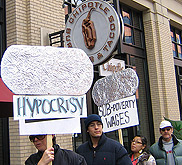
Wednesday, July 1, 2009

Dictionary: hy·poc·ri·sy

Denver Fair Food got a shout out from the CIW. Here's the whole reflection from the CIW website in which Chipotle is lambasted and the Denver Fair Food blog is quoted.

Dictionary: hy·poc·ri·sy
1. The practice of professing beliefs, feelings, or virtues that one does not hold or possess; falseness.


Dictionary: Chi·poc·ri·sy...
6/22/09: The phenomenon known as "Chipocrisy" was in the news this past week, beginning with the June 15th open letter by more than two dozen leading sustainable food activists calling on Chipotle to live up to its claims of "Food with Integrity" and "work with the Coalition of Immokalee Workers as a true partner in the protection of farmworkers' rights."

But it didn't stop there. Also last week, the ABC news show "Nightline" did a piece on Chipotle's relationship with Polyface Farms, a model sustainable farm in Virginia that, in the words of owner Joel Salatin, "fully respects and honors the pigness of the pig."

In the same Nightline story, Chipotle CEO Steve Ells professed, "I think it's really important that people know where their food comes from. I mean we spend a lot of time researching the very best sources, so that when people go to Chipotle, they can rest assured they are getting the very best food."
Really? The Nightline piece, while valuable for shedding light on Mr. Salatin's admirable operation, was incomplete, and therefore deeply flawed. By allowing Mr. Ells to effectively direct the spotlight, the story revealed only that part of Chipotle's supply chain that the company wished to showcase, creating the impression of an ethical restaurant company that indeed earns its claim to "Food with Integrity."

If, however, Nightline had only turned that same spotlight on the fields where Chipotle's tomatoes are picked, perhaps it would have found that the "humanness" of the men and women who pick those tomatoes isn't afforded the same honor or respect.
This might be a good moment to quote a relevant passage from last week's impeccably-timed sustainable food movement letter to Mr. Ells:

"... (F)or us, naturally raised meat – important as it is – does not trump decently treated human beings... Your company has shown admirable leadership in working with – and incubating – meat suppliers willing to meet your higher standards. But your failure to do that same hard work in the Florida tomato industry – together with the Coalition of Immokalee Workers (CIW) – threatens to render your announcement an empty gesture aimed more at public relations damage control than an effort to make real change."

Chipotle's failure to live up to the virtues it professes to hold dear was not lost, however, on one Denver-based blogger last week. Writing on the Denver Fair Food blog, "Robert" noted that, on its corporate website, Chipotle strongly recommends that its customers read Eric Schlosser's hard-hitting analysis of the fast-food industry's ills, "Fast Food Nation". The contradiction was too much to stomach for the Fair Food blogger, who undoes Chipotle's claims to sustainability using a series of quotes by none other than Mr. Schlosser himself. His conclusion is withering, and it shall be our conclusion here as well:

"... It’s abundantly obvious. Quoting Eric again: 'the exploitation of farm workers should not be tolerated in Florida. It should not be tolerated anywhere in the United States. There are many social problems that are extremely difficult to solve. This is not one of them.' Plain and simple, the solution is for Chipotle to work in partnership with the CIW. That’s been Eric’s demand of fast-food companies for a long time and that’s his demand explicitly of Chipotle today.

"It’s funny really, Chipotle isn’t listening to the guy that Chipotle recommends everyone listen to. Chipotle’s 'further reading' is demanding that Chipotle go further, and yet Chipotle refuses to take its own advice. This is a phenomenon that’s become so common place we have a name for it: Chipocrisy.

"That’s the thing about further reading – sometimes you end up eating your words."

Wednesday, June 17, 2009

Further Reading for Chipotle Mexican Grill

Just a few days ago, more than two dozen leading writers, activists, film makers, organizers and farmers from the sustainable food and food justice movements issued an open letter to Chipotle Mexican Grill demanding that the quickly-growing burrito chain work in true partnership with the Coalition of Immokalee Workers to address the ongoing human rights crisis faced by farmworkers in the Florida tomato industry – something Chipotle refuses to do.

The letter is particularly significant because, unlike most fast-food companies which view sustainable food activists as extremists out to destroy the American way of life, Chipotle has worked hard to befriend the movement, trying desperately to depict an image of itself as a innovator in all things sustainable. Hopefully, the letter is a wake up call to the company that, try as it may to convince them otherwise, those truly committed to a more just and sustainable food system will always side with the grassroots struggle of farmworkers fighting for dignity and human rights over the PR spin of corporate elites. Integrity is not something it can buy; integrity is something that must be reflected in its actions.

While the signatories to the letter include many amazing people – from Josh Viertel, president of Slow Food USA, to the inspiring indigenous rights activist Winona LaDuke – hopefully one particular signer will stick out to Chipotle: Eric Schlosser, journalist and best-selling author of a defining book of our times, Fast Food Nation: The Dark Side of the All American Meal.

You see, at the end of Chipotle’s pretentious “manifesto” titled “Food With Integrity” in which it claims its goal is “no less ambitious than revolutionizing the way America grows, gathers, serves and eats its food,” Chipotle lists as one of two books in its suggestions for “Further Reading” none other than “Eric Schlosser’s Fast Food Nation.” That’s a bold move for any fast-food company and particularly for one that used to be owned by McDonald’s. After all, Schlosser’s book is an uncompromising critique of the fast-food business model and the ways in which it has warped and harmed our food system on every level. Is Chipotle agreeing then that Schlosser is correct about everything that needs to change about the fast-food industry?

If so, then there are even further readings that Chipotle should have done a long time ago. Anyone who’s been following the Campaign for Fair Food for a while knows that Eric Schlosser is a long-time supporter and close ally of the CIW.

Chipotle would have done well to listen to Eric’s opinion in a New York Times column back in 2005 following the Taco Bell Boycott victory: “Food-service companies now purchase the majority of fresh produce in the United States - and farmers often believe that cutting wages is necessary to cut prices for their largest customers. Meaningful change, therefore, will have to come from the top . . . Taco Bell deserves credit for acknowledging its responsibility on this issue. Now McDonald's, Burger King, Wendy's and Yum's other brands need to do the same.” For more of Eric’s commentary on the need for fast-food companies to take responsibility for protecting farmworkers rights from the pages of the Times, Chipotle could have read here or here.

Or perhaps, Chipotle would have preferred to hear Eric testifying side by side with Lucas Benitez of the CIW in front of a US Senate hearing on Florida farm labor just last year where he said, “the immediate solution to these problems, however, does not lie with the federal government or with state officials in Florida. The largest purchasers of Florida tomatoes must take responsibility for the labor conditions in which those tomatoes are produced. Fruit and vegetable farmers today are under enormous pressure to cut operating costs. They face increased competition from overseas suppliers and price reductions imposed by their largest customers . . . Today the major fast food chains stand atop America’s food chain. Their purchasing decisions can transform entire sectors of the nation’s agricultural economy.” He added, in case anyone believed that reforms could happen without the participation of farmworkers themselves, that “the Coalition of Immokalee Workers has been one of the few brave and effective defenders of migrants in the state of Florida.”

If Chipotle wants change as badly as Eric, it should know that when asked if he sees “actual reform of the food system occurring,” Eric’s immediate response was “there's no question that meaningful reform has begun. The Coalition of Immokalee Workers, a wonderful organization that defends the rights of farm workers in Florida, has forged agreements with the leading fast food chains and with Whole Foods.” Yet, oddly Chipotle has rebuked the opportunity to make actual reform that’s been placed at its door step (literally).

It’s also recommended that Chipotle check out this video promo for the movie Food, Inc. (of which Eric is a co-producer) in which he heaps praise on the CIW.

And before Chipotle pats itself on the back anymore for “revolutionizing” our food system, Eric is quite straightforward: “at the moment, the majority of Americans – ordinary working people, the poor, people of color – do not have a seat at this table. The movement for sustainable agriculture has to reckon with the simple fact that it will never be sustainable without these people.” Chipotle really should read – and answer – this question that Eric, again while sitting next to the CIW, posed to a panel at the Slow Food Nation gathering last summer: “Does it matter whether an heirloom tomato is local and organic if it was harvested with slave labor?” Just so Chipotle is clear, “the answer is obvious.”

It’s abundantly obvious. Quoting Eric again: “the exploitation of farm workers should not be tolerated in Florida. It should not be tolerated anywhere in the United States. There are many social problems that are extremely difficult to solve. This is not one of them.” Plain and simple, the solution is for Chipotle to work in partnership with the CIW. That’s been Eric’s demand of fast-food companies for a long time and that’s his demand explicitly of Chipotle today.

It’s funny really, Chipotle isn’t listening to the guy that Chipotle recommends everyone listen to. Chipotle’s “further reading” is demanding that Chipotle go further, and yet Chipotle refuses to take its own advice. This is a phenomenom that’s become so common place we have a name for it: Chipocrisy.

That’s the thing about further reading – sometimes you end up eating your words.

Monday, June 15, 2009

Food justice leaders to Chipotle: "We view the CIW’s struggle for dignity as a non-negotiable part of the struggle for a sustainable food system."

"Food, Inc." director (Robert Kenner) and co-producer (Eric Schlosser, author of Fast Food Nation) join more than two dozen sustainable food movement leaders in an open letter to burrito giant Chipotle!

In a strongly worded letter, more than two dozen of the country's leading sustainable food activists are demanding that Chipotle, the fastest growing company in fast-food, live up to its claims of "Food with Integrity" and "work with the Coalition of Immokalee Workers as a true partner in the protection of farmworkers' rights."

Frances Moore Lappe ("Diet for a Small Planet"), Raj Patel ("Stuffed and Starved"), Josh Viertel (President, Slow Food USA), and Robert Kenner and Eric Schlosser (director and co-producer the critically acclaimed new documentary on the food industry, "Food, Inc.") are just a few of the voices for a more just food system that added their names to the open letter. Here's an excerpt:

"We realize that Chipotle has announced that it's paying an extra penny per pound for tomatoes, but we have to ask: What has Chipotle done since that announcement to identify and cultivate growers who are willing to raise their labor standards and pass the penny along to their workers? Your company has shown admirable leadership in working with – and incubating – meat suppliers willing to meet your higher standards. But your failure to do that same hard work in the Florida tomato industry – together with the Coalition of Immokalee Workers (CIW) – threatens to render your announcement an empty gesture aimed more at public relations damage control than an effort to make real change."

The letter comes in the wake of last week's news of an important breakthrough in the Campaign for Fair Food -- Whole Foods' announcement that two of Florida's leading organic producers, Alderman Farms and Lady Moon Farms, will implement the company's agreement with the CIW, including the penny-per-pound wage increase and a strict code of conduct.

We could not have said it better. Denver Fair Food is proud that, despite all Chipotle's attempts to sell itself as a sustability savior, the real sustainable food movement sees that their interests lie more with the diligent efforts of a grassroots farmworker organization than with the self-serving PR claims of a fast-food corporation. While Chipotle can remain a stubborn holdout against working with the CIW, it cannot expect those who believe in a just and sustainable food system to languish with it.

Monday, June 8, 2009

Stalemate broken! Two FL growers to implement CIW agreement with Whole Foods...

Alderman Farms and Lady Moon Farms, two of Florida's largest organic growers, officially onboard to pass penny-per-pound on to workers, meet strict labor standards...


Whole Foods Market has confirmed that two of Florida's largest organic growers have agreed to implement the principles of the Campaign for Fair Food, effectively breaking the stalemate established nearly two seasons ago when the Florida Tomato Growers Exchange threatened to fine any of its members that sold tomatoes under the terms of the CIW agreements. At that time, two Florida growers who had been passing on the penny-per-pound increase under the Taco Bell agreement ceased doing so. See the CIW website for all the details!


Press coverage of this great news included this cheeky commentary from MSNBC: "The one chain the CIW hasn't been able to entice over to the light side is Chipotle, which has been tsk tsked for responding with a snubby 'thanks, but no thanks.' C'mon, Chipotle, your burritos are overpriced as it is, what's a few more cents?"


One more excuse has crumbled for Chipotle Mexican Grill, and we at Denver Fair Food are apparently not the only ones wondering: Will the burrito chain now finally give up its pretensions and condescension toward farmworkers, and at last reach an agreement in authentic parnership with the CIW?

Wednesday, May 20, 2009

from the Prax(us) art show

Prax(us) is an organization which addresses human trafficking in the state of Colorado. One of the things that makes them an incredible organization, especially in the anti-human trafficking world, is their commitment to an anti-oppression model of community work. Like the Coalition of Immokalee Workers, Prax(us) believes that the communities most effected by modern-day slavery need to be the ones who lead the struggle against it, and that human trafficking and slavery need to be combatted on an institutional level, not just on an individual case by case basis. Given the similarities in philosophy and overlapping issues, Prax(us) is an ally that we've been proud to have at the Denver Fair Food Committee in our work in solidarity with the CIW.

Recently, Prax(us) hosted an art show exploring the intersections between human trafficking and reproductive justice, worker rights, immigrant rights and LGBTQ rights. Unfortunately, not all the incredible art can be shared on this blog but here is the piece that I submitted about the modern-day slavery in the fields of Florida:
And here is an explanation I included with the drawing:

Farmworkers in the Florida agricultural industry face a wide range of human rights abuses, the most extreme of which is modern-day slavery. Since 1997, Florida has witnessed seven successful prosecutions of slavery rings - involving more than 1,000 workers forced against their will to harvest the food we eat.

Slavery does not occur in isolation however. Rather it flourishes from the fertile ground of "sweatshop conditions" and the historical roots of chattel slavery and racism. Tomato pickers earn just 40 to 50 cents for each 32lb bucket of tomatoes they pick - a wage rate that has not increased since 1978. A farmworker will earn $50 if she or he manages to pick two tons of tomatoes in a day. They do not receive sick leave, health insurance or benefits of any kind for performing this dangerous, back-breaking work all day. Farmworkers are explicitly denied the right to overtime pay and the right to organize or join a union - legal exclusions which can be traced back to Southern agriculture's demand for cheap Black labor.

Given this everyday, normal environment where farmworkers have so little control over the terms of their labor, it is all too predictable that at times the exploitation will tip over into the more extreme and brutal form of modern-day slavery.

I decided to display a simple photocopy instead of the original because it isn't intended to be fine art but rather an accesible and reproduceable tool for consciousness raising and dialog. It's inspired by the Coalition of Immokalee Workers (CIW) - a grassroots farmworker organization that has been instrumental in combating slavery in Florida's fields. The CIW uses popular education drawings, similar to this one, to collectively reflect on their experiences and forge a plan action.

You can download a copy of the drawing here.

Thursday, May 7, 2009

First Victory in 'Dine w/ Dignity' Campaign!

Big news in the Campaign for Fair Food!
Bon Appetit - a leading food service provider for universities - has committed to improving the wages and working conditions of Florida farmworkers in another VICTORY for the Coalition of Immokalee Workers! See the CIW website for all the latest news: www.ciw-online.org.

With another major corporation reaching an agreement to work in partnership with the CIW, the question looms: Why does Chipotle continue to resist a true partnership with the CIW?

Speaking of Chipotle, check out the last blog post for a point by point reality check of the claims that Chipotle's spokesperson makes everytime he's asked about the CIW.