Friday, December 11, 2009

Steve Ells Challenged to a Debate on the Merits of the Campaign for Fair Food!


In an incisive critique of Chipotle's asinine excuses for not joining the Campaign for Fair Food, Food and Society Fellow Sean Sellers has thrown down the virtual gauntlet and challenged Chipotle CEO Steve Ells to a debate. Below is an excerpt from the must-read article.

Read Sean's full article on Grist.org:
Food with Integrity?
Steve Ells, will you accept the "Chipotle Challenge?"

“Of course I’m not in favor of slavery! But signing an agreement [with the Coalition of Immokalee Workers] does not actually change those conditions for farmworkers,” Steve Ells, CEO of Chipotle Mexican Grill, gibed in front of an audience of 250 at the University of Pennsylvania’s prestigious Wharton School of Business on November 19. “I mean, they just don’t see the bigger picture,” he continued. “To change the fast-food paradigm is huge. We’re trying to do the right thing.”

Ells’ defensive posture came in immediate response to a question posed by Marina Saenz-Luna, a staff member of Just Harvest USA, who works closely with the Florida-based Coalition of Immokalee Workers (CIW). Since 2006, the grassroots farmworker organization has petitioned Chipotle – a leading fast-casual restaurant chain specializing in gourmet burritos – to enter into an agreement to improve wages and working conditions for Florida tomato pickers. Four years later, farmworkers’ and consumers’ stomachs have soured in light of Chipotle’s persistent hostility towards the workers’ organization.

It didn’t have to be this way. Ells founded Chipotle in 1993 with an $85,000 start-up loan from his father. The venture has since bloomed into one of Fortune’s 100 fastest-growing companies with over 800 restaurant nationwide. Along the way, Chipotle has emerged as a self-styled leader in the fields of sustainable agriculture and socially responsible supply chain management through its highly publicized commitment to “Food With Integrity.”

Chipotle explains on its website that, “‘Food With Integrity’ isn’t a marketing slogan.” Rather, it “means working back along the food chain. It means going beyond distributors to discover how the vegetables are grown, how the pigs, cows and chickens are raised, where the best spices come from.” For his part, Ells, the chef-cum-corporate executive, reflects, “Learning about this dark side of modern agriculture made me want to find out how we could do things differently.”

Yet Chipotle has responded to the human rights crisis in Florida’s fields – including seven federally prosecuted cases of modern-day slavery since 1997 – with silence, evasion, and cynical spin. And Ells seemingly has no compunction about using his high-profile speaking engagements to spread misinformation about the CIW’s Campaign for Fair Food and the impact of his company’s policies on farmworkers.

What is at stake is not mere public relations dividends or quarrels over the meaning of “integrity.” Chipotle apparently believes that farmworkers are incapable of developing mutually beneficial solutions to the problems they face within the agricultural industry. And though Chipotle is but a tiny player within a massive food industry landscape, their stance flies in the face of core principles painstakingly advanced by the Campaign for Fair Food over the past decade: farmworker participation in the protection of their own labor rights; supply chain transparency; and third-party verification and monitoring.

It’s easy to shut down debate and mock earnest criticism when one stands alone at the podium and holds the microphone. But a closer reading of the recent exchange between Ells and Saenz-Luna belies a festering insecurity within Ells and his company over its chosen course of action.

So here’s my challenge: Let’s have a real debate, Mr. Ells, at any public forum of your choosing. After all, if you can’t back up your position, then integrity demands that you change it.

Read the full article on here at Grist.org.

Friday, December 4, 2009

Denver is on the move!

It’s been a while since we’ve provided an update. But that’s not because nothing has been happening in Denver. On the contrary, we’ve been too busy to have time to update everyone.

On Friday November 20th, the Student Advisory Committee to the Auraria Board (SACAB; a student government body comprised of representatives from the three different universities housed on the Auraria Campus) passed a resolution urging the campus food service provider Sodexo to work with the Coalition of Immokalee Workers. The resolution reads in part:

“AHEC [Auraria Higher Education Center] has an ongoing contractual relationship for the provision of catering and dining services with the food service corporation Sodexo; and . . . we, SACAB Representatives, through our student fees, and the use of catering services fund this food service contract between AHEC and the Sodexo corporation . . . THEREFORE, BE IT RESOLVED that SACAB urges the Sodexo corporation to meet with the CIW to negotiate the terms for directly improving Florida tomato pickers' wages by $.01 per pound of tomatoes, and, together with the CIW, implement an enforceable, human rights-based Code of Conduct for its tomato supply chain.”

The other student government bodies at Auraria are moving forward with passing resolutions of their own.

The same day as SACAB passed it’s resolution, students from throughout the Front Range gathered on the Auraria Campus to discuss participating in the Dine With Dignity campaign on the own campuses and coordinating their efforts with students throughout Denver and around the state. Sodexo is not only the food service provider on Auraria Campus but also on all the other campuses in Denver and many campuses throughout Colorado. And students from those many campuses are preparing to take action to hold Sodexo accountable for the human rights abuses occurring in it’s tomato supply chain.

Meanwhile, a delegation of Denver Fair Foodistas paid a visit to a certain Denver-based “fast casual” restaurant chain. No, not THAT restaurant chain. This time it was a visit to the corporate offices of sub-sandwich giant Quiznos. Unlike our other experiences with Denver’s other fast casual food corporations, Quiznos actually listened to us in a respectful manner and even expressed support for the principles of Fair Food. Of course, more than just words are needed; action is needed, and we will be watching Quiznos closely to ensure that it joins the growing mass of corporate food purchasers cooperating with the CIW to create a more just food system.

(We hope that Chipotle doesn’t like think that we’ve forgotten about it just because we’re paying attention to Quiznos. No need to feel left out, Chipotle, we've still got an eye for you!)

During this same busy week, Denver consumers also participated in the National Supermarket Week of Action by delivering letters to the mangers of King Sooper supermarkets demanding that Kroger (King Sooper’s parent company and the largest supermarket chain in the country) join in agreement with the CIW.

Throughout the country, the Campaign for Fair Food is pressing forward at rapid speed. Pickets, rallies, marches, letter drops, street theater and more have been breaking out from California to Florida. Just next week the CIW is holding a major march on headquarters of the Florida-based supermarket Publix while student and grassroot allies are planning a demonstration outside the corporate offices of food service provider Aramark in Philadelphia as part of the Fair Food Solidarity Tour led by United Workers.

Everyone in Denver has a lot to be proud of as part of this incredible movement.

Monday, November 16, 2009

Campus Gathering for 'Dine with Dignity'

Friday, November 20th
2:00pm-4:00pm
at Auraria Campus
Multicultural Lounge, Tivoli Student Union builidng
900 Auraria Pkwy., Denver, CO
Map

Calling all students, faculty and staff from Front Range colleges and universities:
Join us for a meeting to share information and make plans for a "Dine with Dignity" Campaign targeting campus food service provider Sodexo.

Dine with Dignity is a campaign led by the Student/Farmworker Alliance in solidarity with the Coalition of Immokalee Workers (CIW) to demand that major dining services contractors such as Sodexo take steps to improve the wages and protect the human rights of farmworkers who pick tomatoes bought by these companies.

These companies often hold monopolies on campus dining and catering and charge us exorbitant prices for meals and catering, while we have little input into what ends up on our plates, where it comes from or how it was produced. However by working together in alliance with farmworkers, we can hold Sodexo accountable to the demands of students and workers for human rights and greater participation at all levels of the food supply chain.

Sodexo is one of the largest food service providers in the country and has contracts with all the campuses in Denver -- Regis University, University of Denver and Auraria (home to University of Colorado Denver, Metro State College of Denver and Community College of Denver) -- as well as other universities in Colorado including Ft. Lewis College, Colorado State University and University of Colorado at Colorado Springs.

We hope we can coordinate our efforts to bring pressure to bear on Sodexo.

Contact Angelica@sfalliance.org for more info

Background:
Florida tomato pickers receive sub-poverty wages and are denied fundamental worker rights like overtime pay and the right to organize. They earn about 45 cents for every 32-lb. bucket of tomatoes they pick – a rate that has not changed significantly in 30 years. At that rate, a worker must harvest over 2.5 TONS of tomatoes to earn the equivalent of Florida minimum wage for a 10-hour workday. In the most extreme cases, this everyday sweatshop climate of little pay and little rights tips over into actual modern-day slavery. More info

The Coalition of Immokalee Workers is a Florida-based grassroots organization of farmworkers who are fighting for human rights and dignified working conditions. Their work combating modern-day slavery has garnered them international recognition.

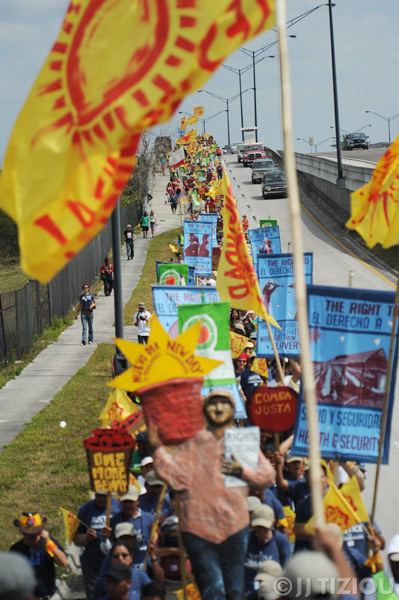
Through the Campaign for Fair Food, the CIW in alliance with consumers has sought to hold major fast-food chains and food retailers accountable for the human rights crisis faced by farmworkers in their supply chains. The Campaign for Fair Food has led to precedent-setting agreements with Yum! Brands (owner of Taco Bell, KFC, and others), McDonald's, Burger King, Subway and Whole Foods. Most recently the CIW reached an agreement with Compass Group, one of the nation's largest campus food service providers.

For more background, see here.

Sunday, November 8, 2009

Denver knows how to party!

The people of Denver have been working hard for 2+ years to build alliances with and advance the grassroots struggle of farmworkers in Florida. And last Friday we celebrated our hard work, knowing that such bonds between communities are the foundation for the better world for which we're all fighting.


But we weren't just there to celebrate our past, imbibe tasty drinks, and enjoy delicious tomato-themed snacks. This was also a celebration of our future. Denver Fair Food has big plans for the struggle ahead and we need EVERYONE to join with us. There is a lot to watch out for including rumors of a campus upsurge against Sodexo, solidarity with grocery workers in negotiation with King Soopers, increasing scrunity of Denver's own Quizno's, and of course the ongoing struggle with Chipotle.

Wednesday, November 4, 2009

300 Defeated!

In testament to the fact that there ain't no power like the power of the people 'cause the power of the people won't stop, a broad coalition of Mile High City organizations soudly defeated Initiative 300 with 70% of voters casting a whopping "NO."

The Colorado Immigrant Rights Coalition statement on the victory:
From the Denver Post:

Wednesday, October 28, 2009

No on 300 / Chipotle's 'Integrity' slogan draws heat

Everyone in Denver is encouraged to vote NO on Initiative 300 on the Denver ballot. To learn more go here. Also there are still important voluteer opportunities to get out the vote to defeat this initiative which you can inquire about here.

The 'vehicle impound initiative' was brought to the ballot by local anti-immigrant zealots, and it's impact will be disproportionately felt by poor people and communities of color. Everyone from the Libertarian Party to the police to the Denver Area Labor Federation oppose it. It is misleading, vague and dangerous.

Speaking of things which are misleading, vague and dangerous, Chipotle comes to mind. We want to share with you an article that actually got the story right about Chipotle where so many other journalists have failed. Coming to us from the Fresno Bee:

Chipotle's 'Integrity' slogan draws heat
Published online on Tuesday, Oct. 13, 2009
by Jane Obra

As Chipotle Mexican Grill tests its new kids' menu, the company faces scrutiny over its slogan, "Food With Integrity."

First, some background: The Denver-based chain is pushing kids' meals -- such as the $3.95 taco kit and the $3.50 small meat and cheese quesadilla -- at its restaurants in Fig Garden Village, Clovis and Visalia.

There are deals on Sundays between Oct. 18 and Nov. 8. On these days, children get a free meal when their parents buy one adult entree.

To boost sales, Chipotle is touting its philosophy. The chain buys some organic and locally grown produce. It uses meat from humanely-raised animals; they are fed a vegetarian diet and are free of antibiotics and added hormones. And its cheese and sour cream don't come from cows treated with synthetic recombinant bovine growth hormone (rBGH).

"It's never been more critical for kids to learn the importance of making smart food choices," says Steve Ells, founder, chairman and co-chief executive officer of Chipotle. "We've found a way to make dining fun for kids and parents alike -- we fuss over quality ingredients so parents don't have to."

Well, some folks are fussing over Chipotle's use of Florida tomatoes. The nonprofit Coalition of Immokalee Workers says Chipotle doesn't do enough to ensure fair pay and safe conditions for the workers who pick its tomatoes.

Between December and May, the nation's tomato supply comes primarily from southern Florida. Pickers earn 45-50 cents for every 32-pound bucket of tomatoes, the coalition says. That's about the same wage they earned 40 years ago.

Some of these pickers even live in virtual slavery. Last year, the Navarrete family made headlines for its treatment of 12 immigrant farmworkers.

In court documents, workers described staying in locked trucks and shacks with no toilets. They say they were beaten and forced to pay for food, as well as the privilege of bathing with a garden hose. Brothers Cesar and Geovanni Navarrete pleaded guilty to counts of deprivation of civil rights.

It wasn't an isolated incident. Since the late 1990s, prosecutions in seven similar court cases resulted in the freedom of more than 1,000 workers.

By highlighting these problems, the coalition pressured Burger King, McDonald's, Subway and other retailers into paying a penny more per pound for Florida tomatoes -- a wage increase that would go directly to the pickers. These agreements with the coalition force retailers to buy only Florida tomatoes that meet a mutual code of conduct.

Chipotle did not sign an agreement with the coalition. Company spokesman Chris Arnold told the Rocky Mountain News in 2006 that its Florida tomato suppliers met Chipotle's standards.
"Just because an activist group doesn't like what we're doing, it doesn't mean there's something wrong with what we're doing," Arnold said. "Not all tomato growers are the same. They're painting all of the Florida tomato industry with the same brush."

Chipotle offered another reason for resisting an agreement with the coalition. The Florida Tomato Growers Exchange, which counts most Florida tomato growers as members, forbade the growers from paying workers the extra money. About $1.5 million in payments for farmworkers sits in an escrow account, says Lucas Benitez, a member of the coalition.

A breakthrough occurred when East Coast Growers and Packers, which bills itself as one of Florida's three largest tomato growers, dropped out of the exchange. It has since signed deals directly with Chipotle, Compass Group (a leading food service company) and McDonald's, pledging to pass on the penny-per-pound raise to the farmworkers, says Batista Madonia Jr., East Coast's vice president and sales manager.

East Coast is the third farm to pass the penny-per-pound raise directly to workers. In June, Lady Moon Farms and Alderman Farms signed a similar agreement with Whole Foods Market.
Benitez praises Whole Foods, Compass Group and McDonald's for having agreements with both the coalition and these farms.

He is wary about Chipotle because the coalition doesn't have oversight of its agreement with East Coast.

Chipotle benefits from good publicity over its relationship with East Coast, but it "is not obligated to continue to pay the penny and to continue to empower the code of conduct because they don't have any agreement with the farmworkers," Benitez says.
For its part, Chipotle declined to provide its code of conduct, but Arnold says it explicitly addresses "such important issues as third-party auditing, treatment of workers, wages and working conditions, and pesticide and chemical usage, among others."
-->
The columnist can be reached at jobra@fresnobee.com or (559) 441-6365. Read her blog at fresnobeehive.com/ author/joan_obra.

Wednesday, October 21, 2009

"Our tomatoes are picked by slaves"


This photo was snapped in April of 2006 somewhere around the Twin Cities in Minnesota. Aside from it bringing a smile to our faces, we're sharing it here today not in order to claim that Chipotle's tomatoes are or ever have been picked by slave labor. Perhaps Chipotle would like to answer that question?

What we do have to say is just a quick comment on what will be necessary to end the all too real slavery in the Florida agricultural industry and Chipotle’s failure in this regard.

We propose that the elimination of slavery will necessitate that farmworkers have the ability to participate at all levels in the protection of their own rights. After all, since it is farmworkers’ powerlessness and lack of a voice in the industry which has set the stage for them to be easily exploited and at times enslaved, ending that exploitation would logically require that farmworkers have greater power over their lives and labor and be able to decide for themselves what’s in their best interest. Furthermore, the incredible progress which we are witnessing toward farmworker justice has come about only because farmworkers themselves joined together as the Coalition of Immokalee Workers and fought for it – without the people in the fields leading the struggle, change would never and will never occur.

What did Chipotle exclude from its recent agreement with East Coast Growers which it boasts will improve the wages of tomato pickers? Chipotle excluded farmworkers from participating at any level in the protection of their own rights.

Excluding farmworkers from developing, monitoring and enforcing the standards which they believe are necessary for the defense of their rights is a sure fire way to stall improvements of working conditions and make reforms meaningless. It is the perfect way to maintain a status quo in which exploitation and abuse thrive.

Chipotle’s approach comes in stark contrast to the recent other agreement that East Coast Growers made to improve the wages and working conditions of farmworkers – this one with the CIW and the major food service provider Compass Group. Not only does the East Coast, CIW, Compass agreement, provide for much higher standards for workers’ rights and working conditions than Chipotle's, but at the heart there is a fundamental difference which Rev. Noelle Damico beautifully captured at the announcement of the agreement: “This is not an agreement in which farmworkers are ‘done unto.’ Farmworkers have been full partners in the creation of this agreement and will be full partners in its implementation, because the agreement and its partners recognize each other as human beings who are entitled to respect, voice, and participation.”

Talk all it will about antibiotic-free chicken, “food with integrity,” and even making “a difference in the lives of workers who pick tomatoes for Chipotle,” Chipotle is still on the side of slavery as long as it is not on the side of workers. Sin el pueblo no hay la justicia.