Sunday, February 14, 2010

Shrinking from the Challenge?... Food writers pick up on "Chipotle Challenge"; meanwhile, silence from Ells...

In December 2009, Food and Society Fellow Sean Sellers challenged Steve Ells (pictured left), the CEO of Chipotle Mexican Grill, to a public debate on the merits of the Campaign for Fair Food. The challenge stemmed from Chipotle's ongoing refusal to partner with the CIW to address labor conditions in its tomato supply chain, and in response to misinformation about the CIW spread by Ells in recent high-profile speaking engagements.

Since then -- though Ells has yet to answer the call -- the Chipotle Challenge has certainly caught the attention of national food writers who have seized upon the jarring contradiction at the heart of Chipotle's billion-dollar brand.

In an excellent feature-length article ("One Company Thinks They've Created Fast Food with a Conscience -- Are They Right?," 2/9/10), Tara Lohan of AlterNet writes:

"'Chipotle had no idea it was buying from one of the growers tainted by the most recent slavery prosecution until the CIW told them about it,' said Sellers. 'They would have known much earlier if they had a real working relationship with the CIW.'

... Whether Chipotle will be willing to team up with CIW in an effort to improve labor conditions is yet to be seen. Sellers has invited Ells to a public debate about the issue, but Ells has yet to take him up on the offer. Still, it's not too late for Ells to be consistent about changing the fast-food paradigm."
And a month earlier, the food blog Simple, Good and Tasty posed a series of hard-hitting questions for Ells ("Chipotle Doesn't Support Florida Tomato Pickers? Say it ain't so, Steve," 1/14/10):

"So, my first question to Steve Ells would simply be, why?

Question #2 would be this: Are you willing to tarnish the reputation of your company over this seemingly no-brainer issue? How could you possibly object to doing everything you can to improve the plight of poor and powerless farmworkers in Florida’s tomato fields? (That would be question #3.)

And, finally, do you know how much you are hurting the people who care about you, who have held you in such high esteem, who depend on you to provide inexpensive, convenient, delicious, nutritious and sustainably sourced food that appeals to practically everyone?

Admit you have a problem, Steve. That’s the first step. Now solve it. Pledge your full and unconditional support to CIW and Florida’s tomato pickers. Do it for them. Do it for your customers. Do it for your investors. Do it for your friends and family. Do it, because, as you say on your website, you can always "do better." Prove it. Thank you."
Will Ells accept the Chipotle Challenge? The clock is still ticking.

Wednesday, February 3, 2010

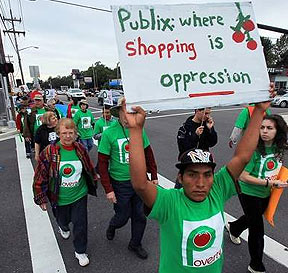
Farmworker Freedom March, April 16-18

Already plans are underway for folks from Denver to participate in this important and exciting action. It will be a great opportunity for the Denver community to strengthen our connections with the workers in Immokalee and our commitment to the struggle for Fair Food. If you're interested in attending, contact us at DenverFairFood@gmail.com.

CIW announces "Farmworker Freedom March," Tampa to Lakeland, Florida, April 16-18, 2010!

March to call for: "Freedom from forced labor; Freedom from abuse; Freedom from poverty and degradation"

President Obama declared January, 2010, "National Slavery and Human Trafficking Prevention Month," saying:

"Fighting modern slavery and human trafficking is a shared responsibility. This month, I urge all Americans to educate themselves about all forms of modern slavery and the signs and consequences of human trafficking. Together, we can and must end this most serious, ongoing criminal civil rights violation."
Join us this spring for an intensive campaign of education and action to end modern-day slavery in Florida's fields.

Details:

Farmworker Freedom March
* Three-day march of farmworkers and allies
* April 16-18, from Tampa to Lakeland (home of Publix)
* Route details and logistics to be announced soon
Background:

The fight to end modern-day slavery has been gaining important ground in recent months. Ten months ago, Florida Governor Charlie Crist wrote these words in an open letter to the CIW, after the Governor and his representatives met in Tallahassee with CIW members and victims of modern-day slavery cases:

"I have no tolerance for slavery in any form, and I am committed to eliminating this injustice anywhere in Florida. I unconditionally support the humane and civilized treatment of all employees, including those who work in the Florida agricultural industry. Any type of abuse in the workplace is unacceptable.

I support the Coalition's Campaign for Fair Food, whereby corporate purchasers of tomatoes have agreed to contribute monies for the benefit of the tomato field workers. I commend these purchasers for their participation..."
Three months ago, the Collier County Sheriff's Department joined with the CIW in organizing "A Day without Slavery," a community event "aimed at providing seasonal farm workers and members of the Immokalee community with information about human trafficking and ways to identify victims of human trafficking." Speaking of the Immokalee farmworker community, Detective Charlie Frost told the Naples Daily News ("Immokalee event geared toward raising awareness of human trafficking," Naples Daily News, 11/14/09):

“They are our eyes and ears out here,” Frost said. “They’re the ones that will be able to alert us to these trafficking type of situations. It’s important that they know they have rights as victims.”

And this month, President Obama declared January 2010 "National Slavery and Human Trafficking Prevention Month". The proclamation states, in part:

"The United States was founded on the principle that all people are born with an unalienable right to freedom -- an ideal that has driven the engine of American progress throughout our history. As a Nation, we have known moments of great darkness and greater light; and dim years of chattel slavery illuminated and brought to an end by President Lincoln's actions and a painful Civil War. Yet even today, the darkness and inhumanity of enslavement exists. Millions of people worldwide are held in compelled service, as well as thousands within the United States. During National Slavery and Human Trafficking Prevention Month, we acknowledge that forms of slavery still exist in the modern era, and we recommit ourselves to stopping the human traffickers who ply this horrific trade...

... The victims of modern slavery have many faces. They are men and women, adults and children. Yet, all are denied basic human dignity and freedom. Victims can be abused in their own countries, or find themselves far from home and vulnerable. Whether they are trapped in forced sexual or labor exploitation, human trafficking victims cannot walk away, but are held in service through force, threats, and fear. All too often suffering from horrible physical and sexual abuse, it is hard for them to imagine that there might be a place of refuge...

... Fighting modern slavery and human trafficking is a shared responsibility. This month, I urge all Americans to educate themselves about all forms of modern slavery and the signs and consequences of human trafficking. Together, we can and must end this most serious, ongoing criminal civil rights violation."
You can read the proclamation in its entirety here. Its words reflect the fierce urgency of the fight to end this most violent form of exploitation.

The movement to end modern-day slavery is not an issue of partisan politics, and it's definitely not a labor dispute. It is a movement to defend one of our most fundamental human rights, and the CIW has been at the forefront of that movement for many years.

Yet when we asked Publix to adopt the principles of the Campaign for Fair Food -- principles, including a zero tolerance policy for slavery, designed to eliminate forced labor and its causes -- Florida's largest supermarket chain turned its back.

Instead, Publix continued to purchase tomatoes from the very farms tainted by the latest slavery prosecution. When asked why, Publix spokesperson Dwaine Stevens told the St. Augustine Record:

"... the chain does purchase tomatoes from the two farms but pays a fair market price." ("Farmworkers protest supermarket tomatoes," 11/24/09)

But there is no "fair market price" for slavery, and there will be no end to modern-day slavery until companies like Publix stop turning a blind eye to human rights abuses in their suppliers' fields.

Help us send a message that Publix cannot ignore. Join us this spring for the Farmworker Freedom March, for a march you -- and Publix -- will never forget.

Check the CIW website http://www.ciw-online.org/ more information on all the action this spring!

Wednesday, January 27, 2010

"Admit you have a problem, Steve."

It is not a shock that Chipotle CEO Steve Ells has not responded to, much less accepted, the "Chipotle Challenge." When long-time ally of the CIW Sean Sellers dared Ells to a head-to-head debate to publicly defend his weak excuses for refusing to join in agreement with the CIW, I suspected that Ells would not have the integrity to stand behind his words and would opt instead for ignoring Sean.

Fortunately, at least one of Chipotle's most loyal customers doesn't want to let Ells hide from his problems. In an excellent post titled "Chipotle Doesn't Support Florida's Tomato Pickers? Say it ain't so, Steve." from the Simple Good and Tasty blog, Shari Danielson - a consumer who "trully cares" about the chain - encourages us to:

"Try to imagine a situation in which someone whom you deeply care about -- a friend, a family member, a co-worker -- is doing something wrong and totally out of character, say cheating on his wife, gambling away his children's college funds, stealing from his employer. Now, imagine how you would react to his bad behavior. Chances are, if you really care about this person, you wouldn’t ignore it; you would confront him about it, right? You would probably tell him how much he means to you, and that you don’t want to see him or the people in his life get hurt as a result of his actions. Maybe you would even organize an intervention."

She then explains, "I feel this way about Chipotle now." She goes on to summarize Sean Sellers' documentation of Chipotle's "silence, evasion and cyncial spin" in the face of farmworkers' just demands.

She ends with these tough questions and strong advise for Ells:

"So, my first question to Steve Ells would simply be, why?

"Question #2 would be this: Are you willing to tarnish the reputation of your company over this seemingly no-brainer issue? How could you possible object to doing everything you can to improve the plight of poor and powerless farmworkers in Florida’s tomato fields? (That would be question #3.)

"And, finally, do you know how much you are hurting the people who care about you, who have held you in such high esteem, who depend on you to provide inexpensive, convenient, delicious, nutritious and sustainably sourced food that appeals to practically everyone?

"Admit you have a problem, Steve. That’s the first step. Now solve it. Pledge your full and unconditional support to CIW and Florida’s tomato pickers. Do it for them. Do it for your customers. Do it for your investors. Do it for your friends and family. Do it, because, as you say on your website, you can always 'do better.' Prove it. Thank you."

I can't claim to share Shari's high opinion of Chipotle. I've had too much experience with Chipotle to not conclude that "Food With Integrity" is more a marketing ploy intended to exploit our dreams of a fair and sustainable food system than a true desire to "do better." Steve, it can't be too long 'til your most loyal customers start to come to the same conclusions. If you want to "do better," than the task in front of you is simple: "Prove it. Thank you."

Thursday, January 14, 2010

Mistreatment of Range Workers in Colorado

Florida of course is not the only state where agricultural workers face brutal exploitation and social marginalization. Right here in Colorado, there is no doubt poverty wages, harsh living and working conditions, and gross imbalances of power which provide fetile ground for abuse to flourish for workers in the state's agricultural industry.

The great folks at Colorado Legal Service's Migrant Farmworkers Division just issued an eye-opening report about the plight of Colorado's range workers - most of whom are from Peru but also from countries such as Nepal. Here's a brief write up about the report:

A report being released today found that more than 80 percent of a surveyed group of Colorado's sheep, goat and cattle herders are not permitted to leave their ranches, according to Colorado Legal Services.

Much of the treatment of herders is entirely legal due to the exclusion of herders from many of the federal regulations that govern the H-2A program. Sheepherders in Colorado receive a standard wage of $750 per month, as little as $2-3 per hour, regardless of hours worked, and are required by their contracts to be on-call 24 hours per day. Their housing is not required to have electricity, running water and toilets.

The report, conducted by legal services' Migrant Farm Worker Division over 2 years, surveyed 93 herders, essentially a third of Colorado's range workers.

Herders typically come to Colorado as part of the H-2A program, a federal program which allows agricultural employers to import temporary workers. The program has long been rife with labor abuses. *Read the CIW's critical analysis of "guest worker" programs here.* That said, almost all other workers in the H-2A program receive better pay, have better living and working conditions, and enjoy more personal freedom than herders do.

"Many herders have expressed concern over the past several years about the harsh conditions under which they live and work," said Jennifer J. Lee, managing attorney of the division and report co-author. "This survey attempted to quantify these concerns to show how prevalent they are."

Many of the herders surveyed expressed concerns about sub-minimum wage pay, long hours, poor living conditions, mistreatment by their bosses and feelings of isolation, according to the report.

Among the most striking statistics revealed by the report:

· Almost three quarters of the herders reported having zero days off over the course of a year.
· Approximately 35 percent were paid less than once a month.
· 85 percent were not allowed to have visitors who were not ranch employees.
· Roughly 70 percent reported never having access to a functioning toilet.
· 85 percent were never permitted to engage in social activities.
· Almost 50 percent reported not having the opportunity or ability to read their employment contracts.

"This report shows that there must be a change in the way herders in Colorado are treated," Lee said. "Herders come a long way from their home countries to work in our state, and they deserve decent wages and living conditions and more control over their own lives."

You can read the full report at http://www.coloradofarmworkers.org/. There are also some interesting articles to come out about the report:
Advocates push change in working conditions for isolated immigrant sheepherders
Poor treatment of immigrant sheep herders alleged
Unsurprisingly, the ranchers quoted in the articles have no shortage of excuses and explanations to justify the exploitation of their employees. Say what they will, an industry whose survival depends on excluding already desperately poor people from basic economic, social and labor rights, has got to rethink its business model.

You can see for yourself the experiences of Colorado range workers by watching the videos at this link. We'll leave you with this one by Grand Junction Alternative Media:

Wednesday, January 6, 2010

A Season of Hope

Happy New Year to all! We wanted to share this new year's message from the Coalition of Immokalee Workers with you which beautifully captures how their long, hard struggle is flourishing and the fruits of justice are ripening.

Chipotle CEO Steve Ells has still not responded to the "Chipotle Challenge," apparently lacking the integrity to defend in public debate his skewed perceptions about and cynical response to the Campaign for Fair food. We hope he takes a moment to read this message.

A season of hope...

Holidays perfect time for a news round-up with a theme of hope for the new year!

A dozen years ago -- shortly before Christmas, 1997 -- a small group of farmworkers in Immokalee began a 30-day hunger strike that would forever transform the struggle for justice in this country's fields. Their excruciating month-long fast cast an unblinking light on the cruel reality facing tomato pickers -- slipping sub-poverty wages, rampant wage theft, and even violent modern-day slavery rings. But more than that, it also exposed the Florida tomato industry’s deeply-rooted, unregenerate resistance to dialogue with farmworkers and to improving farm labor wages and conditions.

In short, the CIW's month-long hunger strike made the case for the Campaign for Fair Food that was to come, for the urgent need for intervention by the multi-billion dollar corporations that purchase Florida tomatoes to demand more modern, more humane conditions in the fields where their tomatoes are grown and picked.

Over the next twelve years, the Campaign for Fair Food grew into a national movement, and the Florida tomato industry continued its stubborn resistance to progress. Even after workers in Immokalee reached landmark agreements with the world's two largest fast-food corporations -- Yum Brands and McDonald's -- to help fund long-needed changes in Florida's tomato fields, the Florida Tomato Growers Exchange threatened to fine any tomato grower willing to pass on the additional funds to improve their workers' wages. Yet the Campaign for Fair Food persevered, patiently building a critical mass of food industry leaders pledged to use their power as major tomato buyers to demand that Florida tomato growers help end poverty and abuses in the fields.

And this year, as the direct result of the collaboration of farmworkers and consumers through the Campaign for Fair Food, true transformation has begun: Three Florida tomato growers are now working with the CIW to implement the Fair Food agreements, including a substantial wage increase, a real voice for farmworkers, and a code of conduct for fair conditions in the fields.

Go to the CIW site today, www.ciw-online.org, where you'll find three stories from the end of this year that capture this pivotal moment in the Campaign from different perspectives. If you have a moment, take a look at the stories and, as you do, savor the fact that these changes can be traced -- day by day, battle by battle -- back to the small, storefront office in Immokalee where six workers took on the trillion-dollar food industry by refusing to eat until their demand for justice was heard.

Thanks - and Happy New Year from the Coalition of Immokalee Workers!

Friday, December 11, 2009

Steve Ells Challenged to a Debate on the Merits of the Campaign for Fair Food!


In an incisive critique of Chipotle's asinine excuses for not joining the Campaign for Fair Food, Food and Society Fellow Sean Sellers has thrown down the virtual gauntlet and challenged Chipotle CEO Steve Ells to a debate. Below is an excerpt from the must-read article.

Read Sean's full article on Grist.org:
Food with Integrity?
Steve Ells, will you accept the "Chipotle Challenge?"

“Of course I’m not in favor of slavery! But signing an agreement [with the Coalition of Immokalee Workers] does not actually change those conditions for farmworkers,” Steve Ells, CEO of Chipotle Mexican Grill, gibed in front of an audience of 250 at the University of Pennsylvania’s prestigious Wharton School of Business on November 19. “I mean, they just don’t see the bigger picture,” he continued. “To change the fast-food paradigm is huge. We’re trying to do the right thing.”

Ells’ defensive posture came in immediate response to a question posed by Marina Saenz-Luna, a staff member of Just Harvest USA, who works closely with the Florida-based Coalition of Immokalee Workers (CIW). Since 2006, the grassroots farmworker organization has petitioned Chipotle – a leading fast-casual restaurant chain specializing in gourmet burritos – to enter into an agreement to improve wages and working conditions for Florida tomato pickers. Four years later, farmworkers’ and consumers’ stomachs have soured in light of Chipotle’s persistent hostility towards the workers’ organization.

It didn’t have to be this way. Ells founded Chipotle in 1993 with an $85,000 start-up loan from his father. The venture has since bloomed into one of Fortune’s 100 fastest-growing companies with over 800 restaurant nationwide. Along the way, Chipotle has emerged as a self-styled leader in the fields of sustainable agriculture and socially responsible supply chain management through its highly publicized commitment to “Food With Integrity.”

Chipotle explains on its website that, “‘Food With Integrity’ isn’t a marketing slogan.” Rather, it “means working back along the food chain. It means going beyond distributors to discover how the vegetables are grown, how the pigs, cows and chickens are raised, where the best spices come from.” For his part, Ells, the chef-cum-corporate executive, reflects, “Learning about this dark side of modern agriculture made me want to find out how we could do things differently.”

Yet Chipotle has responded to the human rights crisis in Florida’s fields – including seven federally prosecuted cases of modern-day slavery since 1997 – with silence, evasion, and cynical spin. And Ells seemingly has no compunction about using his high-profile speaking engagements to spread misinformation about the CIW’s Campaign for Fair Food and the impact of his company’s policies on farmworkers.

What is at stake is not mere public relations dividends or quarrels over the meaning of “integrity.” Chipotle apparently believes that farmworkers are incapable of developing mutually beneficial solutions to the problems they face within the agricultural industry. And though Chipotle is but a tiny player within a massive food industry landscape, their stance flies in the face of core principles painstakingly advanced by the Campaign for Fair Food over the past decade: farmworker participation in the protection of their own labor rights; supply chain transparency; and third-party verification and monitoring.

It’s easy to shut down debate and mock earnest criticism when one stands alone at the podium and holds the microphone. But a closer reading of the recent exchange between Ells and Saenz-Luna belies a festering insecurity within Ells and his company over its chosen course of action.

So here’s my challenge: Let’s have a real debate, Mr. Ells, at any public forum of your choosing. After all, if you can’t back up your position, then integrity demands that you change it.

Read the full article on here at Grist.org.

Friday, December 4, 2009

Denver is on the move!

It’s been a while since we’ve provided an update. But that’s not because nothing has been happening in Denver. On the contrary, we’ve been too busy to have time to update everyone.

On Friday November 20th, the Student Advisory Committee to the Auraria Board (SACAB; a student government body comprised of representatives from the three different universities housed on the Auraria Campus) passed a resolution urging the campus food service provider Sodexo to work with the Coalition of Immokalee Workers. The resolution reads in part:

“AHEC [Auraria Higher Education Center] has an ongoing contractual relationship for the provision of catering and dining services with the food service corporation Sodexo; and . . . we, SACAB Representatives, through our student fees, and the use of catering services fund this food service contract between AHEC and the Sodexo corporation . . . THEREFORE, BE IT RESOLVED that SACAB urges the Sodexo corporation to meet with the CIW to negotiate the terms for directly improving Florida tomato pickers' wages by $.01 per pound of tomatoes, and, together with the CIW, implement an enforceable, human rights-based Code of Conduct for its tomato supply chain.”

The other student government bodies at Auraria are moving forward with passing resolutions of their own.

The same day as SACAB passed it’s resolution, students from throughout the Front Range gathered on the Auraria Campus to discuss participating in the Dine With Dignity campaign on the own campuses and coordinating their efforts with students throughout Denver and around the state. Sodexo is not only the food service provider on Auraria Campus but also on all the other campuses in Denver and many campuses throughout Colorado. And students from those many campuses are preparing to take action to hold Sodexo accountable for the human rights abuses occurring in it’s tomato supply chain.

Meanwhile, a delegation of Denver Fair Foodistas paid a visit to a certain Denver-based “fast casual” restaurant chain. No, not THAT restaurant chain. This time it was a visit to the corporate offices of sub-sandwich giant Quiznos. Unlike our other experiences with Denver’s other fast casual food corporations, Quiznos actually listened to us in a respectful manner and even expressed support for the principles of Fair Food. Of course, more than just words are needed; action is needed, and we will be watching Quiznos closely to ensure that it joins the growing mass of corporate food purchasers cooperating with the CIW to create a more just food system.

(We hope that Chipotle doesn’t like think that we’ve forgotten about it just because we’re paying attention to Quiznos. No need to feel left out, Chipotle, we've still got an eye for you!)

During this same busy week, Denver consumers also participated in the National Supermarket Week of Action by delivering letters to the mangers of King Sooper supermarkets demanding that Kroger (King Sooper’s parent company and the largest supermarket chain in the country) join in agreement with the CIW.

Throughout the country, the Campaign for Fair Food is pressing forward at rapid speed. Pickets, rallies, marches, letter drops, street theater and more have been breaking out from California to Florida. Just next week the CIW is holding a major march on headquarters of the Florida-based supermarket Publix while student and grassroot allies are planning a demonstration outside the corporate offices of food service provider Aramark in Philadelphia as part of the Fair Food Solidarity Tour led by United Workers.

Everyone in Denver has a lot to be proud of as part of this incredible movement.